Status Reimagined: How a Tiny Vinyl Figure Is Changing What It Means to Have Good Taste
There's a particular kind of cultural moment when something small starts casting a very long shadow. A few years ago, Labubu was a niche obsession—beloved by designer toy insiders, traded in tight-knit collector circles, whispered about in Discord servers most people had never heard of. Today, it's sitting on the shelves of people who've never stepped foot in a gallery, being unboxed on TikTok by creators with millions of followers, and quietly becoming one of the most loaded status symbols in a generation that's fundamentally rethinking what status even means.
So what exactly is going on here? And why does it matter?
The Collapse of the Old Status Playbook
For decades, the shorthand for "I've made it" in America was pretty legible. A luxury car. A designer bag. A watch that cost more than most people's rent. These were the markers that said, without saying anything at all, I have resources and taste.
But something has been quietly eroding that playbook, especially among younger consumers. A 2023 survey from Morning Consult found that Gen Z is significantly less likely than older generations to associate traditional luxury brands with personal identity. That doesn't mean they've stopped caring about status—far from it. It means they've started caring about different status signals. Ones that feel more earned, more specific, more culturally legible to the communities they actually belong to.
Enter: the designer toy.
And more specifically, enter Labubu—the wide-eyed, jagged-toothed creature born from the imagination of Hong Kong artist Kasing Lung and amplified globally through Pop Mart's blind box model. What started as a limited art object has become something far more complex: a cultural barometer for a generation that's done playing by the old rules.
Authenticity as the New Currency
Here's the thing about Labubu that doesn't get discussed enough: owning one isn't just about owning a thing. It's about demonstrating that you get it—that you know the artist's background, that you understand the blind box ritual, that you've navigated the scarcity and the secondary market and still showed up.
That knowledge-as-currency dynamic is deeply Gen Z. This is a generation that grew up with infinite access to information and developed extraordinarily fine-tuned radar for authenticity. They can tell the difference between someone who genuinely loves a thing and someone who bought it because it was trending. And in collector communities, that distinction matters enormously.
When someone displays a rare Labubu colorway or a collaboration piece from an artist they've followed for years, it signals something that a Gucci belt simply cannot: I was paying attention before this was cool. That kind of cultural credibility is, for many younger consumers, worth more than any price tag.
Physical Objects in a Digital World—And Why That's the Point
It might seem counterintuitive that a generation raised on screens and streaming would develop such a deep attachment to physical collectibles. But when you think about it, that's exactly why it makes sense.
When everything is infinitely reproducible—when any song, film, or image can be copied and shared a billion times—physical scarcity becomes genuinely meaningful. A Labubu figure can't be screenshotted. It can't be pirated. It exists in your space, on your shelf, in your hands. In a digital-first world, that tangibility is almost radical.
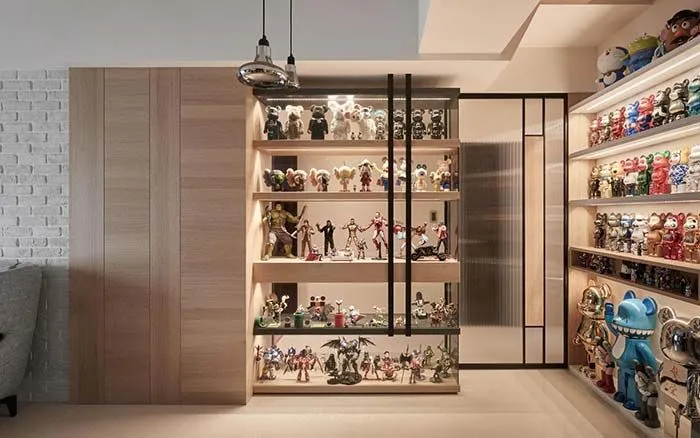
There's also something worth noting about how Labubu functions on social media despite being a physical object. The unboxing video is a ritual. The shelf display is a canvas. The secondary market flip is a narrative arc. These figures move fluidly between physical and digital spaces, which makes them uniquely suited to a generation that lives in both simultaneously. They're not rejecting the digital world—they're using physical objects to anchor themselves within it.
Community Over Consumption
One of the most significant shifts happening in collector culture right now is the move away from collecting as a solitary, acquisitive pursuit and toward collecting as a form of community building. This is especially visible in Labubu circles.
Facebook groups, subreddits, TikTok comment sections, local meetups at pop-ups and conventions—the social infrastructure around Labubu collecting is dense and genuinely active. People aren't just buying figures; they're trading, gifting, debating authenticity, celebrating each other's hauls, and forming friendships that extend well beyond the toy itself.
For a generation that came of age during a loneliness epidemic—one that was only deepened by a global pandemic—that sense of belonging is not a minor thing. It's actually one of the primary draws. The Labubu isn't just a status symbol; it's a membership card.
And that changes the economics of the whole thing. When a purchase also buys you community, the value proposition looks completely different than a traditional luxury transaction. You're not just acquiring an object. You're investing in a social world.
Artistry as a Differentiator
It's also worth taking seriously the art angle here, because collectors absolutely do. Kasing Lung's work has a specific visual language—rooted in Nordic folklore, filtered through a distinctly Asian artistic sensibility, executed with genuine craft. The collaborations Pop Mart has facilitated with other artists and brands have introduced collectors to a rotating cast of creators whose work they might never have encountered otherwise.
This matters because it gives collecting a cultural legitimacy that purely commercial products don't have. When you buy a Labubu, you're engaging with an artistic lineage. That's a meaningful distinction for consumers who want their spending to reflect values—creativity, craftsmanship, cultural curiosity—rather than just financial capacity.
In that sense, the Labubu market is doing something that the traditional art world has historically struggled to do: making fine art sensibility accessible, affordable (at retail, at least), and genuinely fun.
What This Tells Us About Where We're Headed
The Labubu phenomenon isn't just a quirky footnote in the history of consumer culture. It's a signal. It tells us that younger Americans are actively constructing alternative value systems—ones that prioritize authenticity over legacy, community over exclusivity, and artistic meaning over brand prestige.
That doesn't mean traditional luxury is going anywhere. But it does mean the map of status is being redrawn in real time, and designer toys are holding one of the pens.
For collectors, this is a good moment to recognize what you're actually participating in when you add a piece to your shelf. You're not just buying a toy. You're casting a vote—however small—for a different way of thinking about what's worth having, what's worth knowing about, and who's worth knowing.
At Store Labubu, we think that vote matters. And we're here for every single one.