The More You Own, the More You Want: Inside the Collector's Endless Hunger
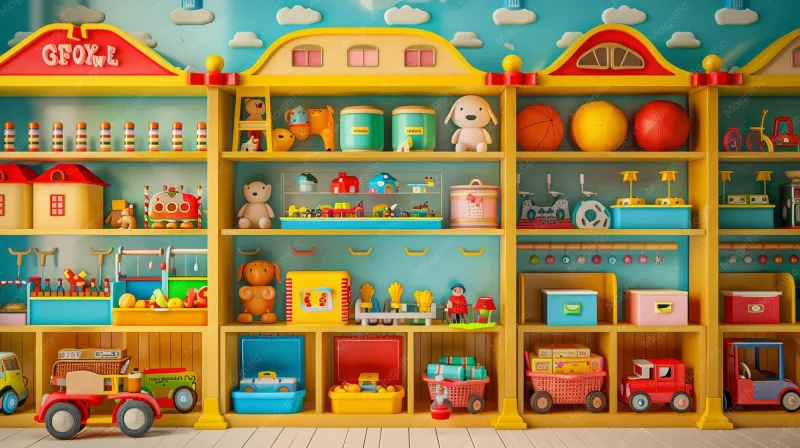
Photo: overflowing designer toy collection shelves colorful figures display, via img.freepik.com
You just got the piece you've been hunting for three months. It's sitting on your shelf, perfectly lit, exactly where you imagined it. And somewhere between the unbox high and the moment you stepped back to admire it, a new tab opened in your brain — already scanning for the next one.
If that sounds familiar, you're not broken. You're a collector. And you're caught in one of the most fascinating psychological loops modern consumer culture has ever produced.
Full Shelves, Empty Feeling
Here's the paradox nobody talks about at the drop queue: the more you accumulate, the more anxious the gaps become. It's counterintuitive. Logic says a full shelf should feel like completion. Psychology says otherwise.
Researchers who study hoarding behavior, consumer psychology, and even gambling addiction all point to a shared mechanism — the brain doesn't reward having, it rewards getting. Dopamine, the neurotransmitter everyone loves to blame, fires hardest during anticipation and acquisition. Once the object is in your hands, the chemical party winds down fast. What you're left with is the figure and a nervous system already scanning the horizon for the next hit.
For collectors, this isn't a bug. It's practically the business model.
FOMO Is a Feature, Not a Glitch
Designer toy culture — and blind box mechanics specifically — is engineered around manufactured urgency. Limited colorways. Regional exclusives. Timed drops. Secret chase figures that show up in maybe one out of every couple hundred boxes. Every structural element of how these products get released is designed to make not buying feel like a loss.
FOMO, or fear of missing out, is well-documented in behavioral economics. But in the collector space, it operates on a different frequency. It's not just social — it's temporal. Miss the drop window and the figure is gone. Not sold out temporarily. Gone. Resale prices spike. The community moves on. You're left with a hole in a collection that nobody else can even see, but you feel constantly.
Algorithmic social media makes this worse in ways that are almost elegant in their cruelty. You follow the right accounts, join the Discord servers, get the notifications — and suddenly your feed is a constant stream of what other people just copped. The acquisition loop doesn't just live in your head anymore. It's being actively fed.
The Completion Urge Is Real (and Relentless)
Ask any serious collector and they'll tell you about the series they "had to finish." Not wanted to. Had to. There's a reason toy companies release figures in series rather than as standalone drops. The completion urge — sometimes called the Zeigarnik effect in psychology circles — is the brain's tendency to fixate on unfinished tasks more intensely than completed ones.
Start a series and your brain registers it as an open loop. Every figure you're missing is a loose thread your mind keeps pulling. Finish the series and the loop closes — briefly — before a new series drops and the whole thing starts over.
This is why collectors who swear they're "only into one character" end up with three full shelves of variants. The original purchase wasn't the commitment. The first gap in the lineup was.
Abundance Anxiety Is a Real Collector Condition
Here's something that doesn't get discussed enough in collector communities: having a lot can feel worse than having a little. When your collection is small, every piece feels intentional. You chose it. It means something. You know the story behind each one.
As the collection grows, a subtle anxiety creeps in. Pieces start competing for attention. The ones in the back of the shelf feel neglected. You start questioning whether you actually like everything you own or whether some of it was just momentum — buying because you were already buying.
This is abundance anxiety, and it's more common than collectors admit. It's that low-grade unease of looking at a shelf that should feel like a victory and instead feeling vaguely overwhelmed by it. The collection has outgrown the story you were telling yourself about it.
When 'Enough' Stops Being a Useful Word
The concept of "enough" doesn't really map onto collector psychology in a clean way. Enough for what? Enough to feel satisfied? Enough to display well? Enough to justify the storage bins in the closet?
For most serious collectors, the honest answer is that the target keeps moving. And that's not necessarily a problem — as long as you're aware it's happening. The collectors who seem to have the healthiest relationship with the hobby are the ones who've made peace with the fact that the desire doesn't end. They've stopped waiting to feel "done" and started finding genuine joy in the ongoing process of curating, trading, and discovering.
That's a different headspace than chasing completion. It's closer to how someone might approach building a record collection or a personal library — not as a project with an endpoint, but as a living expression of taste that evolves over time.
The Honest Audit Nobody Wants to Do
Every collector eventually hits a moment where the collection asks something of them: do you still love this, or are you just maintaining it?
That question is uncomfortable because the answer isn't always flattering. Some of what's on your shelf you bought in a FOMO spiral. Some of it you kept because selling felt like failure. Some of it you genuinely love and would fight someone over.
The collectors who seem most at peace aren't the ones who stopped buying. They're the ones who got honest about why they're buying. Is this piece genuinely exciting, or is the algorithm just showing it to me at the right moment? Is this gap in the series actually bothering me, or am I just conditioned to close loops?
Those aren't easy questions. But they're the difference between a collection that reflects who you are and a shelf that just reflects what was available at checkout.
The Loop Doesn't Have to Own You
None of this is a takedown of collecting. The desire to acquire, curate, and surround yourself with objects that mean something to you is deeply human. It shows up across every culture and every era. Designer toys just happen to be an exceptionally well-designed vehicle for that impulse in 2024.
But understanding the mechanics — the dopamine cycles, the FOMO architecture, the completion urge — gives you something valuable: a little distance. Enough to ask whether the next drop is something you want or just something your brain has been primed to reach for.
Sometimes the answer is still yes. And that's fine. The best collections are built from genuine desire, not just reflexive acquisition.
The shelf looks better that way, too.