More Than a Hobby: The Complicated Truth About Who You Become When You Collect
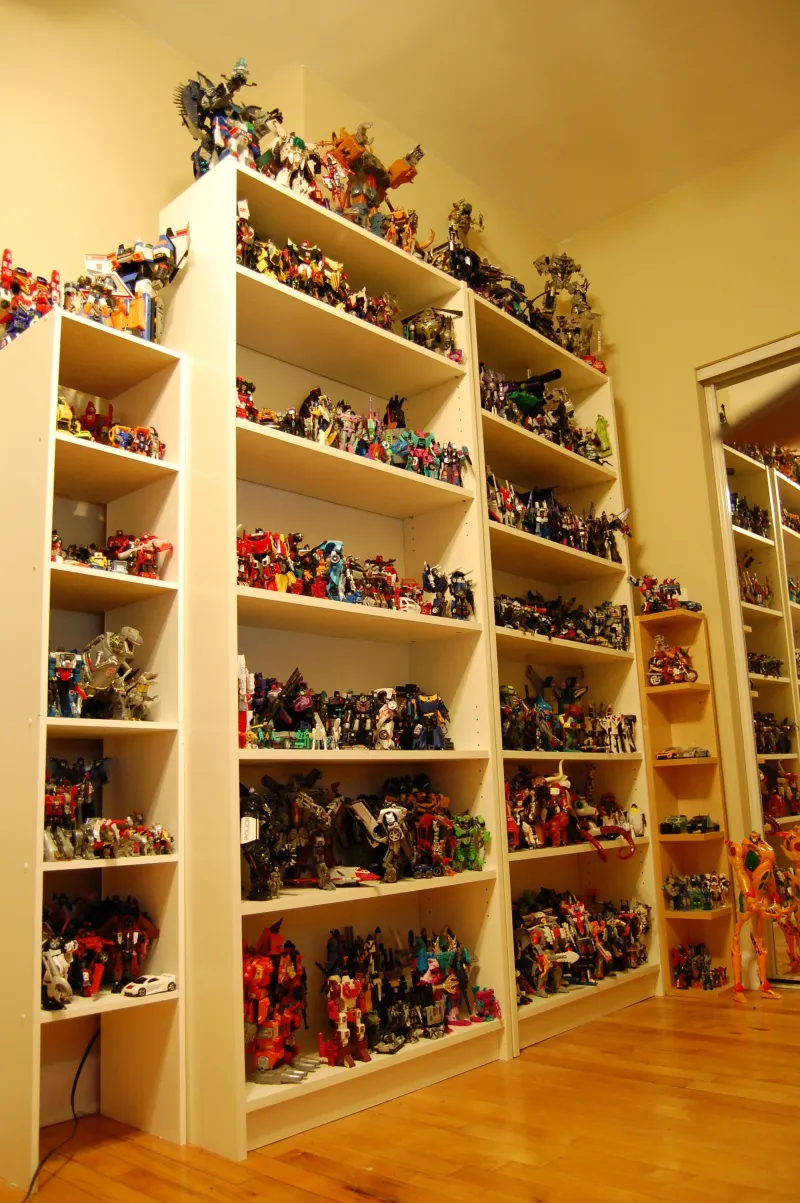
Photo: person thoughtfully looking at colorful toy collection display shelf, via i.pinimg.com
Jamila had 47 figures when she realized something had shifted. Not 47 she'd carefully curated over years — 47 she'd accumulated in about fourteen months. She'd started with three Labubu pieces she genuinely loved, and then, somewhere between the Discord servers and the Instagram unboxings and the thrill of a chase piece finally landing on her doorstep, the collection had taken on a momentum of its own.
"I couldn't tell you the last time I bought something because I thought it was beautiful," she says, sitting in her apartment in Austin, Texas, surrounded by shelves she describes as "a little out of control." "I was buying because I didn't want to miss out. Because everyone else in the group was getting it. Because not having it felt like falling behind somehow."
Jamila's story isn't unique. It's not even unusual. In the designer toy collecting community — a space built on genuine artistic appreciation, community belonging, and the primal joy of the hunt — the line between passionate hobby and compulsive consumption can blur in ways that sneak up on you.
The Shelf as Self-Portrait
Let's be clear about something upfront: there is nothing inherently wrong with loving designer toys. The artists who create these pieces are genuinely talented. The communities built around them are often warm, creative, and deeply knowledgeable. The joy of finding a piece you love, displaying it beautifully, and connecting with other people who get it — that's real, and it's worth celebrating.
But collecting, at its most psychologically interesting, is never purely about the objects. It's about what the objects mean. And in the designer toy space specifically, where limited editions signal taste, where resale value implies savvy, and where a well-curated shelf photographs like a personality — the identity dimension is impossible to ignore.
Dr. Priya Mehta, a licensed therapist in New York who works with clients navigating compulsive spending patterns, describes it this way: "Collecting can be a beautifully healthy form of self-expression and community connection. It can also become a vehicle for something else entirely — anxiety management, social comparison, a way of constructing an identity through external objects rather than internal development. The tricky part is that those two things can coexist in the same person, in the same collection."
The Community Loop
Designer toy communities — particularly the ones organized around specific characters or brands — are, at their best, genuinely supportive spaces. People share finds, authenticate pieces for each other, celebrate new releases together. There's a real sense of belonging.
But community dynamics can also create pressure that collectors don't always recognize in the moment. When your social world is organized around people who are all buying, displaying, and discussing the same category of objects, "normal" spending behavior gets recalibrated fast.
Tyler, a 29-year-old collector from Seattle, describes joining a Labubu-focused Discord server as a turning point — but not entirely a positive one. "It's an incredible group of people. Genuinely. But when you're in a space where everyone is posting their latest haul every day, you start to feel like you're falling behind if you're not also acquiring. It's not that anyone pressures you directly. It's more like... the ambient norm shifts."
This is what social psychologists call normative influence — the way group behavior establishes unspoken standards that individual members feel pressure to meet. In collecting communities, this can manifest as spending escalation that feels organic but is actually socially driven.
The Acquisition High (And What Comes After)
Anyone who's waited anxiously for a package, torn open a blind box with genuinely shaking hands, or finally secured a chase piece they'd been hunting for weeks knows the feeling. It's real, it's intense, and it's — neurologically speaking — quite literally a dopamine hit.
The problem with dopamine is that it habituates. The third blind box in a week hits differently than the first. The tenth limited-edition figure in a month produces less of that electric anticipation than the first one did. And so the natural response — the one our brains push us toward without our conscious permission — is to escalate. Spend more. Hunt harder. Chase rarer.
"I started noticing that the satisfaction after getting something was getting shorter," Jamila says. "Like, I'd be so excited waiting for a package. Then it would arrive, I'd unbox it, take a few photos, put it on the shelf. And within an hour I'd already be browsing for the next thing. The shelf wasn't the point anymore. The chase was."
This pattern — where the anticipation becomes more rewarding than the possession — is well-documented in consumer psychology research and is particularly pronounced in categories with strong gamification elements, like blind boxes.
When Passion Tips Into Something Else
So how do you know if your collecting has crossed a line? There's no clean diagnostic, but collectors and mental health professionals point to a few honest questions worth sitting with.
Are you buying things you don't actually love because not buying them feels worse than buying them? Is your spending creating financial stress you're minimizing or hiding? Do you feel anxious or irritable on days when you're not engaging with collecting content, communities, or purchases? Are the people in your offline life — friends, family, partners — expressing concern that you're not taking seriously?
None of these questions are indictments. They're just honest mirrors. And the collector community, to its credit, has started having more of these conversations publicly. Threads about "no-buy months," discussions about deaccessioning collections to recalibrate, and open posts about the emotional complexity of the hobby are increasingly common — and that openness is genuinely healthy.
Collecting With Intention
The collectors who seem to navigate this space most sustainably tend to share a few characteristics. They have a point of view — a genuine aesthetic or thematic framework for what belongs on their shelf and what doesn't. They can articulate why they love a specific piece beyond "it was limited" or "everyone wanted it." And they maintain some kind of external life that gives the collection context rather than letting the collection become the context.
"My rule is that I have to be able to look at something six months after buying it and still feel something," says Marcus, the Portland collector from our earlier piece. "Not nostalgia for the hunt. Not pride about what I paid or what it's worth. Actually feel something about the object itself. If I can't do that consistently, I know I'm buying for the wrong reasons."
That's not a perfect system. But it's an intentional one. And in a market engineered — by brilliant, well-funded brands — to make intentionality as difficult as possible, having any kind of personal framework is an act of genuine self-awareness.
Your collection can absolutely be part of your identity. Some of the most interesting people in the designer toy space have built something on their shelves that tells a real story about who they are and what they love. The goal is just to make sure you're the one writing that story — not the algorithm, not the Discord server, not the blind box mechanic.
Collect what moves you. Display it with pride. And every once in a while, step back and make sure the shelf is still a reflection of you — not the other way around.