Glass Cases and Grow Lights: How Collectors Are Turning Their Shelves Into Shrines
Let's be honest about something: the moment you drop $80—or $800—on a limited-edition Labubu figure, you've crossed a line. You're not buying a toy anymore. You're acquiring a piece of art with a heartbeat, a character with cultural weight, and an asset that deserves to be treated accordingly. So why do so many serious collectors still have their figures crammed onto IKEA Billy shelves, bathed in overhead fluorescent light, collecting dust next to a Funko Pop they got at Target in 2019?
The display problem is real, and the collector community is finally talking about it out loud.
The Hidden Enemy: Light, Dust, and Time
Before we get into the good stuff—the setups that look like they belong in a SoHo gallery—let's talk about what's actually working against your collection every single day.
UV light is the silent killer. Even indirect sunlight streaming through a window can cause vinyl figures to yellow, fade, and develop surface cracking over years. That vivid pop of color on your Macaron Labubu? It's degrading in real time if it's sitting near a window. Fluorescent lighting isn't much better—it emits UV radiation at low levels, which adds up over months of continuous exposure.
Dust is the second villain. It sounds trivial until you realize that particulate buildup can cause micro-scratches on painted surfaces when you wipe figures down, and certain types of dust carry moisture that accelerates material breakdown. Open shelving looks casual and accessible, but it's essentially a slow-motion disaster for high-end figures.
Humidity and temperature fluctuations round out the threat list. Vinyl is more sensitive to environmental shifts than most collectors realize. A garage storage situation or a basement display in a humid climate isn't just inconvenient—it's actively shortening the life of your pieces.
What Serious Collectors Are Actually Building
The good news is that the collector community has been quietly developing a playbook for display setups that address all of these issues without making your living space look like a climate-controlled warehouse.
The entry point for most dedicated collectors is the DETOLF upgrade. IKEA's glass-door cabinet has been a staple for years, and while the base unit is solid, collectors have built an entire ecosystem around improving it. Third-party LED strip kits with color temperature control, custom acrylic risers and tiered platforms, and aftermarket door locks are all available through Etsy sellers and specialty retailers who cater specifically to the designer toy crowd. For under $200 total, a modded DETOLF is a genuinely respectable display solution.
Step up from there and you're looking at dedicated display cases from brands like Ikee Design, Meooeck, and Action Figure Display Cases—companies that have recognized the collector market and built products specifically for it. These units typically feature UV-filtering glass or acrylic panels, adjustable interior lighting, and lockable doors. Price points range from $150 to $600 depending on size and features.
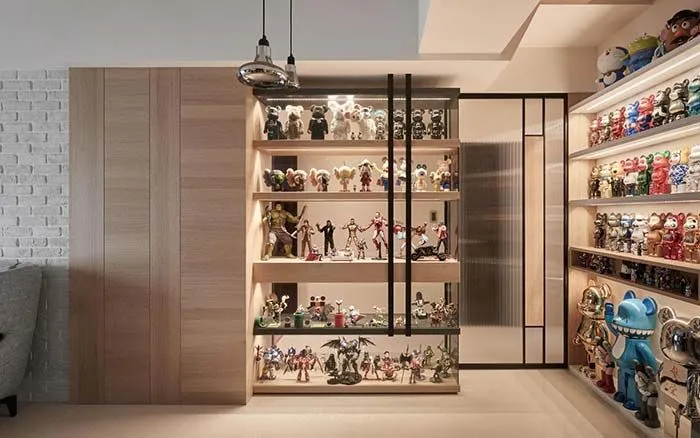
At the top of the market, collectors are commissioning custom built-ins from local cabinetmakers or working with specialty companies that build museum-grade display furniture. Think floor-to-ceiling units with integrated LED systems, individual spotlighting for hero pieces, and materials chosen specifically for their archival properties. These setups run into the thousands, but for collectors with five-figure inventories, the math starts to make sense pretty quickly.
Lighting Is Everything (And Most People Get It Wrong)
If there's one variable that separates a mediocre display from a jaw-dropping one, it's lighting. And the collector community has gotten genuinely sophisticated about this.
The goal is warm, directional light that flatters the figures without generating UV radiation or heat. LED strips rated at 2700K to 3000K color temperature hit that sweet spot—they render colors accurately without the harsh blue-white cast that makes vinyl look cheap. Many collectors layer their lighting: ambient strips along the top of each shelf for overall illumination, with small spotlight pucks positioned to create drama around hero pieces.
Bias lighting—placing LED strips behind the display unit against the wall—has become popular for the way it creates depth and makes the whole setup feel more intentional, almost cinematic. It's a technique borrowed directly from home theater setups, and it translates beautifully to figure displays.
One thing to avoid: RGB color-changing strips that cycle through the rainbow. They look incredible in unboxing videos and genuinely terrible in person. Pick a color temperature and commit to it.
The Curation Conversation Nobody's Having
Here's the thing that gets overlooked in every "display tips" thread on Reddit and every YouTube shelf tour: the physical setup is only half the equation. What you put in that setup—and how you arrange it—matters just as much as the case you put it in.
Some of the most visually striking collections aren't the biggest ones. They're the most edited ones. Collectors who treat their shelves the way a gallery treats its walls—rotating pieces in and out, creating intentional groupings, leaving negative space—end up with displays that feel like a statement rather than an inventory.
Colorway groupings work beautifully with Labubu figures specifically, because the character's consistent silhouette lets the color variations sing without visual chaos. Chronological arrangements tell a story about the collection's history. Theme-based groupings—pastoral editions together, collaboration pieces in their own zone—create sub-narratives within the larger display.
The point is that curation is a skill, and it's one worth developing deliberately. Your display isn't just storage. It's the argument you're making about why these objects matter.
Budget Reality Check
Not everyone is ready to drop $2,000 on a custom built-in, and that's completely fine. The display upgrade journey is a spectrum, and any move toward intentionality is a move in the right direction.
Start with UV-filtering acrylic panels if you have open shelving—they're inexpensive and make a real difference. Add a simple LED strip kit. Get some acrylic risers to create depth and hierarchy within your existing setup. These changes together can run under $100 and will meaningfully improve both the look and the longevity of your collection.
As your collection grows in size and value, let your display investment grow with it. The collectors with the most impressive setups didn't build them all at once—they iterated over time, learning what worked and what didn't, and gradually leveling up their infrastructure as their taste and their inventory demanded it.
The Bottom Line
Collecting designer toys at any serious level is a three-part practice: acquisition, authentication, and display. Most of the conversation in this community focuses on the first two. But how you house and present your figures is the part that determines whether your collection is a pile of stuff or a genuine expression of who you are and what you value.
Your Labubu figures are extraordinary objects. They deserve an extraordinary home. Start there, and figure out the details as you go.