Too Many Figures, Not Enough Wall: The Space Crisis Every Serious Collector Eventually Faces
It starts innocently enough. A shelf here, a display case there. Maybe a few figures lined up on the windowsill because the light hits them just right. Then one day you're standing in your apartment, holding a brand-new Labubu you waited three weeks for, and there is genuinely nowhere to put it. Not a single square inch of real estate left on any surface you own.
Welcome to the collector's apartment problem. It's not glamorous, it's not aesthetic, and nobody posts about it — but it's one of the most universally shared experiences in the designer toy world.
The Math Nobody Warns You About
Collecting sounds like a hobby. It feels like a lifestyle. But at a certain scale, it becomes a logistics problem.
Marcus, a 31-year-old graphic designer based in Brooklyn, started collecting about four years ago with a modest IKEA Kallax and a handful of figures. Today he owns north of 200 pieces and has colonized every flat surface in his 650-square-foot apartment. "I have figures on top of the refrigerator," he says, without a trace of irony. "I have a Labubu sitting next to my bathroom sink. I didn't plan it that way. It just... happened."
This is the trajectory almost every serious collector describes. The collection doesn't grow on a schedule — it grows in bursts. A limited drop here, a convention haul there, a trade that lands you three figures when you only expected one. Before long, the display space you thought was more than enough is a distant memory.
And here's the thing about designer toys specifically: they're not small. A single Labubu Mega in its box takes up real shelf space. Stack a few of those with their original packaging and you've eaten through an entire IKEA shelf unit before you've even gotten to the regular-sized pieces.
The Psychological Cost of Keeping Figures in Boxes
For a lot of collectors, the real gut punch isn't running out of space. It's what happens next: the figure goes back in the box, back in the closet, and slowly disappears from daily life.
"There's this thing that happens when you box something up," says Dani, a 27-year-old collector in Austin who runs a small collector account on Instagram. "It stops being part of your world. You still own it, technically, but it doesn't bring you any joy because you never see it. It's like having a painting and keeping it in storage. What's the point?"
This is more than just a practical frustration — it touches on something core to why people collect in the first place. The figures you can see every day become part of your environment, your identity, your mood. The ones living in shoeboxes in the back of your closet might as well not exist. Collectors who've had to archive large portions of their collections often describe a low-grade grief about it, a sense that part of their personality has gone underground.
The psychological research on this is actually pretty solid: people form genuine emotional attachments to physical objects, and removing those objects from view creates a real sense of loss — even when the object is technically still yours.
Rotation: The Strategy That Changes Everything
The most common solution collectors land on — and the one that tends to stick — is the rotation model. Instead of trying to display everything at once, you treat your shelves like a gallery that cycles through its collection on a schedule.
Marcus rotates his display every six to eight weeks. He keeps about 40 pieces out at any given time and cycles the rest through labeled, climate-controlled storage bins in his closet. "It actually made me appreciate the collection more," he admits. "When you pull something out of storage that you haven't seen in two months, it feels new again. You notice details you forgot about."
The key to making rotation work is organization. Collectors who do this well tend to invest in proper storage: acid-free boxes, silica gel packets to manage humidity, and a cataloging system — even if it's just a spreadsheet — so you always know what you have and where it lives. Apps like Collectibles Database or even a basic Notion setup can help you track your full inventory without having to physically dig through boxes every time you want to find something.
The Brutal Edit: Deciding What Stays
Some collectors take a harder approach. Instead of rotating, they force themselves to make permanent decisions: what's display-worthy enough to earn a spot on the shelf, and what gets sold, traded, or archived indefinitely.
This is genuinely difficult. Every figure in your collection came with a story — a drop you stayed up for, a trade you negotiated, a birthday gift from someone who actually understood your taste. Letting go of any of them feels like erasing a chapter.
But collectors who've gone through a serious edit often describe it as liberating. "I sold about 60 pieces last year," says Jordan, a 34-year-old collector in Chicago. "I kept only the ones I'd be devastated to lose. My collection is smaller now, but every single thing on my shelf means something. There's no filler."
The framework Jordan uses is simple but effective: if a figure wouldn't make the cut for a curated display in a gallery, it doesn't make the cut for the shelf. Everything else gets sold at fair market value through the collector community or through resale platforms.
Creative Space Solutions Worth Stealing
Beyond rotation and editing, collectors have gotten genuinely creative about squeezing more display capacity out of limited apartments:
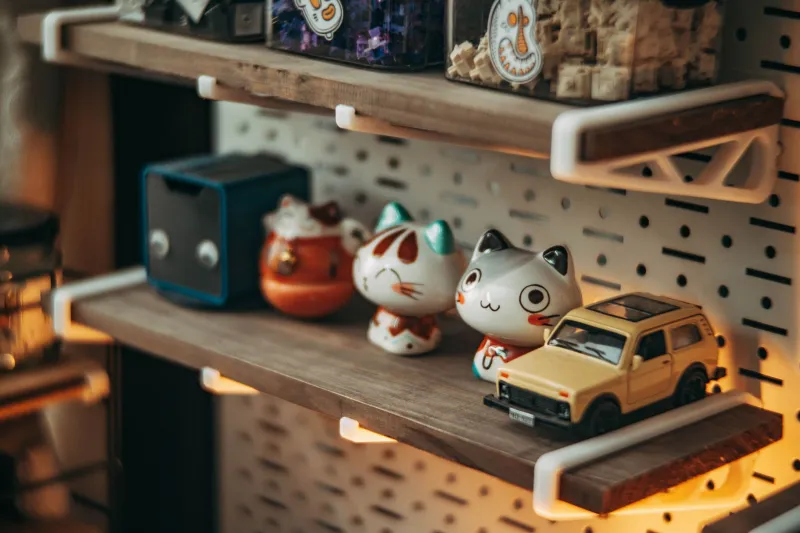
Wall-mounted floating shelves — Going vertical is the obvious move, but collectors are doing it at scale. Floor-to-ceiling gallery walls of floating shelves can hold a surprising number of figures without eating into floor space.
Acrylic risers and tiered displays — These let you stack depth into a single shelf, displaying figures in two or three rows without losing visibility on any of them.
Dedicated display cabinets with lighting — IKEA's Detolf and Billy bookcase with glass doors are collector staples for a reason. Add LED strip lighting and suddenly your storage is also your most impressive piece of furniture.
Under-bed storage for archived pieces — Flat, rolling storage containers under a bed frame are ideal for boxed figures you're not currently displaying. Out of sight, but organized and accessible.
Repurposing unexpected spaces — Floating shelves in hallways, above doorframes, or in bathroom niches are underutilized in most apartments. Collectors who think architecturally about their space find square footage that most people overlook.
The Harder Question Underneath All of This
At some point, the space problem stops being about shelves and starts being about values. How much of your living environment do you want your collection to occupy? Where's the line between a curated, intentional display and a space that's started to feel chaotic?
There's no universal answer, and that's kind of the point. Some collectors want their whole apartment to be an immersive expression of their taste — figures everywhere, all the time, unapologetically. Others want a tighter, more gallery-like edit that keeps the space livable for anyone who walks through the door.
Both are valid. The collectors who seem happiest are the ones who've made a conscious choice about which camp they're in, rather than letting the collection make that choice for them by default.
Because here's the thing: the figures don't have opinions about where they live. You do. And the collection you build — the way you display it, rotate it, edit it, and live with it — says something real about who you are and what you actually value.
That's worth thinking about, even when you're holding a brand-new Labubu and staring at a shelf with absolutely no room left on it.